Getting a driver’s license in Thailand is a straightforward process, though the written exam is famous for having some awkwardly translated questions.
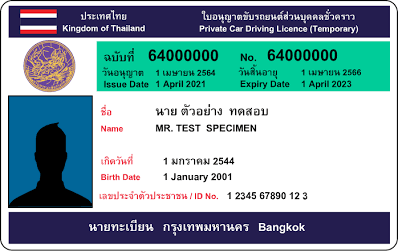
If you are a foreigner applying for a new Thai driving license (or converting a foreign one without an International Driving Permit), you will need to go through the Department of Land Transport (DLT).
Here is exactly what you need to know to prepare, practice, and pass the exam.
1. The Paperwork (What to Bring)
Before you can take any test, you must have your documents in order. You will need:
- Passport: Original and photocopies of your photo page and current visa.
- Medical Certificate: A standard document stating you are fit to drive. You can get this at almost any local clinic or hospital for about 100–300 THB. (Must be issued within the last 30 days).
- Certificate of Residence: Issued by your country’s embassy or the Thai Immigration office. (Must be issued within the last 30 days).
- Note on converting licenses: If you already hold a valid license from your home country (along with an International Driving Permit) or a license from a country with a mutual agreement, you are generally exempt from the theory and practical exams.
2. The Exam Process
If you are starting from scratch, here is the order of operations on test day:
1.Physical Tests:
You will undergo a quick set of physical tests. These include checking for color blindness (identifying traffic light colors), depth perception (aligning two pegs in a box), reaction time (hitting the brake when a light turns red), and peripheral vision.
2.Training Lecture:5 hours for new drivers.
First-time applicants must sit through a 5-hour training video/lecture covering Thai traffic laws, signs, and safe driving. For renewals, it is a shorter 1-hour session, which can often be completed online via the DLT e-Learning website beforehand.
3.The Theory Exam (Written Test):Available in English.
You will take a computerized multiple-choice test. It consists of 50 questions, and you must get at least 45 correct (90%) to pass. The English translations can sometimes be tricky or grammatically confusing, so practice is essential.
4.The Practical Exam (Driving Test):
If you pass the theory test, you move to the driving course. For cars, this usually involves three main maneuvers: driving straight and stopping aligned with a specific line, reversing straight out, and parallel parking into a designated space.
3. Best Resources for the Theory Exam
Because the English phrasing on the official test can be quite literal or slightly confusing, taking practice tests is the absolute best way to prepare. You will start to recognize the specific logic and vocabulary they use.
- Thai Drive Exam (Website): Websites like
thaidriveexam.comanddriving-exam-thailand.comoffer mock exams that mimic the actual DLT test. The questions on these sites are often exact replicas of what you will see on the screen. - Mobile Apps: Search for “Thai Drive” or “Thai Driving Test in English” on the App Store or Google Play. These apps offer hundreds of practice questions, traffic sign flashcards, and mistake tracking.
- Driving Schools: If you want to bypass the wait times at the DLT and have someone guide you through the process, certified driving schools offer 2-day courses (around 3,500 to 5,500 THB). You take the training, theory, and practical test at the school, and they hand you a certificate to take directly to the DLT to print your license.
Sample of Exam
Here is a 10-question sample practice test based on the official Department of Land Transport (DLT) theory exam. The actual exam consists of 50 questions, and you must score at least 90% (45 correct) to pass.
Grab a piece of paper, write down your answers, and check them using the answer key at the bottom!
Thai Driving Theory Practice Test
1. What is the default maximum speed limit for cars in a municipality/city area (unless a sign indicates otherwise)? A) 50 km/h B) 60 km/h C) 80 km/h D) 90 km/h
2. What is the legal Blood Alcohol Concentration (BAC) limit for a regular driver who has held their license for more than five years? A) 0.02% (20 mg/100ml) B) 0.05% (50 mg/100ml) C) 0.08% (80 mg/100ml) D) 0.00% (Zero tolerance)
3. When approaching a roundabout, who has the right of way? A) The vehicle entering from the left B) The vehicle entering from the right C) The larger vehicle D) Vehicles that are already inside the roundabout
4. When you see an emergency vehicle approaching from behind with flashing lights and a siren, what must you do under Thai law? A) Speed up to stay out of its way B) Pull over to the left side of the road and stop C) Pull over to the right side of the road and stop D) Stop immediately in the middle of your lane
5. What does a red and white painted curb indicate? A) Parking is allowed for a maximum of 15 minutes B) You can park here, but only on weekends C) Strictly no parking or stopping at any time D) Parking for taxis and buses only
6. When is it legal to turn left at a red traffic light? A) Anytime, as long as the road is clear B) Only between 10:00 PM and 6:00 AM C) Only when there is a specific sign (usually a blue sign that says “Turn left with safety”) D) Never
7. On a multi-lane highway in Thailand, which lane is legally designated for overtaking? A) The left lane B) The middle lane C) The right lane D) The shoulder
8. If you are applying for a new license from scratch, how long is your first “Temporary” driving license valid for? A) 1 year B) 2 years C) 5 years D) 10 years
9. How many questions must you answer correctly to pass the Thai DLT written theory exam? A) 35 out of 50 (70%) B) 38 out of 50 (75%) C) 40 out of 50 (80%) D) 45 out of 50 (90%)
10. If you are driving in the right lane and a vehicle approaches rapidly from behind, flashing its headlights, what does this usually mean in Thailand and what should you do? A) They are saying hello; flash your hazard lights back B) They want you to move out of the way; safely merge into the left lane to let them pass C) They are yielding the right of way to you; maintain your position D) They are warning you of a police checkpoint ahead
Answer Key
- C (80 km/h). While many countries use 50 km/h in urban areas, Thailand’s default urban limit is 80 km/h.
- B (0.05%). However, if you have held your license for less than 5 years, the limit drops to an ultra-strict 0.02%.
- D (Vehicles already inside). You must always yield to traffic already circulating in the roundabout.
- B (Pull over to the left). Because Thailand drives on the left, you must yield to the left edge of the road, not the right.
- C (Strictly no parking or stopping). Red and white stripes mean no parking or stopping under any circumstances. Yellow and white stripes mean no parking, but temporary drop-offs are allowed.
- C (Only with a sign). You cannot automatically turn left on red in Thailand unless a sign explicitly allows it.
- C (The right lane). Because traffic flows on the left, the rightmost lane is exclusively for overtaking.
- B (2 years). Your first license is probationary and lasts 2 years. After that, you can renew it for a standard 5-year license.
- D (45 out of 50). The pass rate is a notoriously high 90%, meaning you can only afford 5 mistakes.
- B (Move to the left). In Thailand, flashing headlights generally means “I am coming through, get out of the way” rather than “I am yielding to you”.